Showing posts with label Crafts. Show all posts

Thursday, September 1, 2016

Acoma Sky City Cultural Center and Haak'u Museum

Aerial View of Sky City
photo by Marshall Henrie for Wikimedia Commons

Name: Acoma Sky City Cultural Center and Haak'u Museum
Tribe: Pueblo of Acoma
Location: Haaku Road, Pueblo of Acoma, NM 87034
Type: Historic Site, Cultural Center/Museum, Cafe, Gift Shop
Visiting Info: Open daily, 8am-5pm, call for museum hours and tour time registration
Contact: Website, telephone 800-747-0181

The Acoma Pueblo, perched on the top of a 367 ft. high mesa in the New Mexico desert, is one of the oldest continually inhabited settlements in North America. It is approximately 2,000 years old and is home to the San Esteban del Rey Mission church which was completed in 1640. Both the mission and the pueblo are on the National Register of Historic Places and are a site of the National Trust for Historic Preservation.

Sky City Cultural Center
photo from Wikimedia Commons

At the base of the mesa sits the Acoma Sky City Cultural Center and Haak'u Museum building and visitor parking. The Museum offers permanent and rotating exhibits focusing on Pueblo history and the preservation of Puebloan art, specifically Acoma's famous pottery. The 40,000 sq. ft. Cultural Center complex includes the Y'aak'a Cafe, which serves traditional Acoman and contemporary southwestern cuisine, the Ts'ikinum'a Theater showing short films on Pueblo history and culture, meeting/event space with catering options, and the Gaits'i Gift Shop.

photo from Sky City Casino Hotel webpage

Tours of the Pueblo itself are available daily from the Cultural Center, from 8am to 5pm, but it seems best to call ahead (1-800-747-0181) and register for a tour time and to verify current open hours for the Cultural Center's facilities. The pueblo is continually inhabited by a small group of tribal members, and as such, there are sensitivity issues involved with touring the village. The Acoma people ask that dress should be modest (and mindful of the sometimes extreme weather), pets and smoking are prohibited, and photography is not allowed without a permit. Please read the visitor etiquette page. The tours last an hour and a half and cost $23 for adults, $15 for children. Group tours, family rates, and shorter tours of the mission only are also offered.

San Esteban del Rey Mission
photo from Ken Schneider, Flickr's Creative Commons

The Pueblo people celebrate annual feast days that are related to their specific pueblo and mission saint. The feast day of San Esteban is celebrated at Sky City on September 2nd. If you plan to attend, be sure to read up on the specific etiquette rules before you go. Every year in September the Acoma Pueblo also hosts the Tour de Acoma, a series of 25-, 50-, and 100-mile desert bike races. There is also a Luminaria Celebration and dances at the mission church around Christmas. Check the calendar for special events and annual closed days at the pueblo before you schedule your trip.

Sky City is about 70 miles west of Albuquerque and a ways off of I-40, but the Acoma do have a casino hotel and an RV park directly off of the interstate, and they offer big game hunting tours on the reservation in the Fall. Cibola County is also home to the longest uninterrupted stretch of historic Route 66 in New Mexico, which runs immediately to the north of the Casino as State Highway 124.

Tuesday, September 22, 2015

Five Civilized Tribes Museum


Name: The Five Civilized Tribes Museum
Tribe: Muscogee (Creek), Cherokee, Choctaw, Chickasaw, Seminole
Location: 1101 Honor Heights Drive, Muskogee, OK 74401
Type: Art and History Museum, NRHP Historic Building
Visiting Info: Mon-Fri 10am-5pm, Sat 10am-2pm (closed Sundays and all of January), Admission: $1.50-$3
Contact: Website, telephone 918-683-1701

In 1951, a Native women's organization called the Da-Co-Tah Club began a campaign to turn the abandoned Union Indian Agency Building in Muskogee, Oklahoma, into a museum.

The Club's mission since its establishment in the 1930s was to create an intertribal organization to raise awareness of Native history and communities, foster better communication between Nations, strengthen social ties, and meet the needs of their underserved population.

Throughout the Dust Bowl and the Second World War, the Da-Co-Tah women raised money for the Murrow Orphanage, the Drought Relief Fund, the Unemployment Fund, and the Salvation Army, as well as providing services for impoverished children and Native families.

Out of their desire to celebrate Native identity and encourage intertribal cooperation, they envisioned a museum that would showcase the cultures and art of the Five Civilized Tribes of Oklahoma - the Cherokee, Muscogee (Creek), Choctaw, Chickasaw, and Seminole - together. And as part of their vision, they would preserve the building that had once housed the Bureau of Indian Affairs' Superintendent of the Five Civilized Tribes in Indian Territory. The building itself would commemorate the terrible history of the Removal period, the Trail of Tears, and the struggles and survival of the Five Tribes in Oklahoma afterward.

During the 20th century, the Agency Building had passed from the BIA to the Muscogee (Creek) Nation who used it as a school for Creek Freedmen. The Creeks gave it to the city of Muskogee in 1909 as part of Honor Heights Park, and then the city gave it back to the federal government during WWII to be part of the veteran's hospital complex that still stands next door. Seeking to transfer the building back to the town of Muskogee, the Da-Co-Tah Club sponsored a bill in the US House of Representatives with Muskogee-born US Rep. Ed Edmonson in 1954.

The House Bill was signed by President Eisenhower in 1955, the building was restored entirely by privately donated funds raised by the Club, and the Museum was opened in 1966.

Today, the Five Civilized Tribes Museum displays historical exhibits on the ground floor and its art collections upstairs. Many of the Five Tribes' most famous artists have pieces on view, and the Museum owns the world's largest collection of works by Jerome Tiger (Muscogee Creek-Seminole). There is a library and archive upstairs, but it is open by appointment only.

The Museum hosts a yearly Masters Art Show in November and a Student Art Show (grades 7-12) in March. The "Art Under the Oaks" Art Market happens in April, around the time of the Azalea Festival in the adjoining Honor Heights Park.

Wednesday, August 5, 2015

Poeh Cultural Center and Museum

photo from the Pueblo of Pojoaque's website

Name: Poeh Cultural Center and Museum
Tribe: Pueblo of Pojoaque
Location: 78 Cities of Gold Road, Santa Fe, NM 87506
Type: Cultural and Arts Education Center, Museum
Visiting Info: Mon-Sat, 10am-5pm; Free admission, donations accepted
Contact: Website, telephone 505-455-5041

The Poeh Cultural Center and Museum is located about 16 miles north of downtown Santa Fe, NM, at the Pueblo of Pojoaque. The Center was designed to resemble a traditional pueblo with its collection of golden adobe buildings arranged around a series of open plazas. The beautiful architecture is more than just for show. The Center has been used as a training project for teaching traditional construction methods in partnership with the tribally-owned Poeh Pueblo Construction Services Corp.

The construction training program is just one of several projects designed to further the Poeh Center's mission of preserving Pueblo culture and language, promoting artistic expression, and educating both tribal members and non-natives. Although visitors are probably focused on touring the small but well-designed museum and visiting the gift shop, the Center is also home to the Poeh Arts educational institute which includes studio space for local working artists, classes, and an internship program for tribal members who are interested in arts and museum administration. Research archives provide online access to some of the Museum's collections, a photo archive that includes over 10,000 historic and contemporary photographs, and the Oral History Documentation Project. Online access is available by request.

photo from Facebook

More programs are in the works, such as a children's museum, an amphitheater for lectures and dance exhibitions, a larger library/archive facility that would include the Pojoaque Public Library, and a garden.

Already, the Museum has been expanded to include space for artist demonstrations, a gift shop, and a rotating exhibit gallery in addition to the permanent exhibit, Nah Poeh Meng. The word Poeh is the Tewa (one of five Pueblo languages, and the one spoken at Pojoaque) word for "path" and Nah Poeh Meng means "Along the Continuous Path." The imagery of time and culture as a leading path can be found throughout the Center, including the upcoming temporary Pueblo embroidery exhibit, "Paths of Beauty," which opens August 20, 2015.

Sculpture from Nah Poeh Meng
There are more photos on the PCCM website

Nah Poeh Meng leads guests through Pueblo history in six temporal or "seasonal" spaces from the Pueblo origin story to the modern day. The Pueblo people tell this history from their own perspective through art and sculpture made by local artists and storytelling presented as audio in seven languages: Tewa, Tiwa, Towa, Keresan, Zuni, Spanish, and English. The Tewa recordings provide more detailed information for tribal members to have a deeper educational experience with their own culture and "to protect sensitive portions of Pueblo culture." Adding to this examination of the broader Pueblo culture, the current rotating exhibit, "Everything and Everybody," presents the history of the Pojoaque Pueblo specifically.

Beyond the Poeh Center, local art is on display via a self-guided tour at the nearby Buffalo Thunder Resort Casino. The Pojoaque Pueblo also offers several tribally owned restaurants, another casino resort called Cities of Gold, a Hilton Homewood Suites, an RV park, a spa, and a golf course. Guests are welcome during Pojoaque's feast days for Our Lady of Guadalupe on December 12 and July 27, as well as at the King's Day dances on January 6.


Resources:

Friday, July 17, 2015

Cherokee Heritage Center

photo from visitcherokeenation.com

Name: Cherokee Heritage Center
Tribe: Cherokee Nation, United Keetoowah Band of Cherokee Indians
Location: 21192 S. Keeler Drive, Park Hill, OK 74457
Type: Cultural Heritage Complex
Visiting Info: Open year round, Summer (Memorial Day through Labor Day) Mon-Sat, 9am - 5pm, Winter (except Jan 1-14: closed) Tues-Sat, 9am - 5pm; Admission: $5-$8.50.
Contact: Website, telephone 888-999-6007
 
The Cherokee Heritage Center is a complex of attractions that includes the Cherokee National Museum, the Trail of Tears exhibit, Diligwa -  The 1710 Cherokee Village, Adams Corner Rural Village, Nofire Farms, the Cherokee Family Research Center, and the Cherokee National Archives.

The Center also offers special exhibits, cultural workshops, and events, including the Cherokee National Holiday celebration, the Trail of Tears Art Show and Sale, and the Homecoming Art Show.

Trail of Tears Exhibit
photo from cherokeeheritage.org

Artifacts, cultural objects, and art pieces from the span of Cherokee history are on display in the Museum and the Trail of Tears exhibit.

The Diligwa village depicts a traditional Cherokee settlement in the 18th century prior to assimilation. Docents guide visitors through the encampment, explaining traditional culture, crafts, hunting techniques, and games. The self-guided Adams Corner Rural Village and Nofire Farms show what tribal towns looked like after assimilation and the horrors of the Trail of Tears. Set in the 1890's, the seemingly bucolic Rural Village presents the turmoil faced by the Cherokee as Indian Territory began its transition to Oklahoma statehood.

The Swimmer School at the Adams Corner Rural Village
photo from cherokeeheritage.org

The Heritage Center is also home to the Cherokee National Archives, and admission to the complex provides visitors with access to the Cherokee Family Research Center and their genealogical resources. Staff are available to help researchers access Dawes Commission records and the Final Rolls, Seminary records, Cherokee cemetery documentation, and citizenship resources.

The Center is located just to the south of Tahlequah, the Cherokee Nation's capitol, on the grounds of the original Cherokee Female Seminary in an old settlement called Park Hill. The spot is of great historic significance as Park Hill was the home of many important tribal leaders, such as John Ross, in the period after the Removal, and the Seminary was the first educational institution for women west of the Mississippi River.

Park Hill is also home to the John Ross Museum, Ross Cemetery, and the Murrell Home.


Resources:

Sunday, July 5, 2015

Sealaska Heritage Institute's Walter Soboleff Center

Opening Day Ceremonies, May 15, 2015
photo from Facebook

Name: Walter Soboleff Center of the Sealaska Heritage Institute
Tribe: Tlingit, Haida, Tsimshian
Location: 105 S. Seward Street, Juneau, AK 99801
Type: Cultural Heritage and Research Center
Visiting Info: Summer hours: 9am-8pm, daily. Admission: $5, Seniors $4, children under 7 free.
Contact: Website, telephone 907-463-4844

Newly opened on May 15, 2015, the Walter Soboleff Center is Sealaska Heritage Institute's brand new 29,000 square foot cultural arts center in downtown Juneau, Alaska. The Center will serve artists, educators, students, community members, and visitors by providing space for exhibits, art demonstrations, ceremonial events, cultural presentations, and a retail shop. There is also a research facility with archival work and storage space and a Native languages program.

photo from Facebook

The place is so new their website isn't even complete, and I found most of the visiting information listed here on their Facebook page. The beautiful new building in downtown Juneau is named in honor of Tlingit civil rights activist and community leader Walter Soboleff and stands as "a physical manifestation upholding the traditional Native values he held dear."

Artist demonstration in the Center on Free First Friday, June 5.
photo from 
Facebook

Sealaska Heritage Institute is the non-profit arm of the Sealaska Corporation, a for-profit, Native-owned economic development and resource management corporation. SHI administers Sealaska's cultural and educational programs. Language restoration is the primary focus of the Institute, but they also support Native artists, sponsor historical and archival projects, and host the biennial Celebration. The next Celebration will take place in Juneau June 8-11, 2016.


Resources:

Wednesday, June 17, 2015

Ah-Tah-Thi-Ki Seminole Indian Museum

photo from Ah-Tah-Thi-Ki Facebook page

Name: Ah-Tah-Thi-Ki Seminole Indian Museum
Tribe: Seminole Tribe of Florida
Location: 34725 West Boundary Road, Big Cypress Seminole Reservation, Clewiston, FL, 33440
Type: Museum, Cultural Heritage, Traditional Crafts, Library/Archive
Visiting Info: Open everyday (closed some holidays), 9am-5pm, Guided tours by appointment, Library open by appointment, Mon-Fri, 9am-4:30pm; Admission: $7.50-$10
Contact: Website, telephone 877-902-1113

The Seminole Tribe of Florida (along with the Seminole Nation of Oklahoma and the Miccosukee Tribe of Indians of Florida) is one of three federally-recognized tribes of the Seminole people. When the Native people of the Southeastern states were forced to move to Indian Territory, some of the Seminoles retreated into the Everglades, refusing to be removed. Today, the Seminole Tribe of Florida maintains six reservations in the southern part of the state, the largest of which is the Big Cypress Reservation near Clewiston in between Lake Okeechobee and the Everglades National Park.

Big Cypress is home to the tribe's acclaimed Ah-Tah-Thi-Ki Museum. Visitors start out in the museum space which includes a short introductory film and galleries depicting traditional Seminole communities and culture. Changing temporary exhibits explore contemporary Seminole life and people, such as the current exhibit on modern reinterpretations of Seminole patchwork clothing.

Exhibit runs until Nov. 30, 2105.

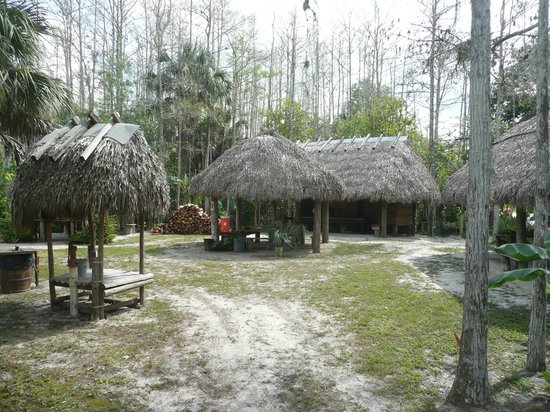
Outside the museum, a raised boardwalk path leads through a cypress grove, past the Clan Pavilion which presents background information on the eight current Seminole clans, to a replica ceremonial grounds and village. In the village, craftspeople demonstrate how they make traditional Seminole art pieces, which are then for sale.

photo from tripadvisor.com

Ah-Tah-Thi-Ki also houses a library and an oral history museum. Much of the oral history recordings are available to tribal members only, but the museum posts some podcasts on their webpage. Some of their archival collections are also online.

Big Cypress Reservation is also home to the Billie Swamp Safari, the Junior Cypress Rodeo and Entertainment Complex, and the Big Cypress RV Resort, all of which are tribally-owned. The Seminole Tribe of Florida also owns several other business enterprises across the state (and the world), including the Hard Rock restaurants and casinos, two of which are on their reservations in Tampa and Hollywood, FL.


Resources:

Monday, May 18, 2015

Mashantucket Pequot Museum and Research Center

credit: pequotmuseum.org

Name: Mashantucket Pequot Museum and Research Center
Tribe: Mashantucket Pequot Tribal Nation
Location: 110 Pequot Trail, Mashantucket, CT, 06338
Type: Museum, Research Library/Archive
Visiting Info: Opening for the season May 15 (through Nov), Wed-Sat 9am-5pm, Admission $12-$20
Contact: Website, telephone (800) 411-9671

After a five-month hiatus for refurbishment under a new director, the Pequot Museum is open again as of May 15, 2015. The museum is hoping to attract greater attention and more visitors with new programs and partnerships with artists.

In the Farmstead area outside, a group of Wampanoag canoe-builders is working on a 36-foot mish8n ("mishoon," the Wampanoag word for canoe), which will be the longest canoe built in New England in the last 200 years when it is completed in June 2015. Visitors can also see a 400-year-old dugout canoe on display inside the museum's exhibits hall.

The Pequot Café is open with a new menu featuring indigenous selections made from local ingredients sourced when possible from Native vendors.

The museum is also offering free work studio space for local Native artists who would like to become Artists in Residence. (For more information contact: bburrell@pequotmsueum.org, 860-396-6960)

And of course, there is still the original 85,000 square feet of permanent, indoor exhibits, including the Pequot Village, a recreation of a 16th Century Pequot settlement before and after contact with Europeans. The movie theater shows The Witness, a 30-minute film about the attack of the Mystic fort by colonists. The "Life on the Reservation," "The Mashantucket Pequot Tribal Nation Today," and the "Portrait Gallery" areas discuss life for Pequot citizens in Connecticut today and the state of the Tribe since they secured federal recognition in 1983.

On the museum grounds, a 185-foot glass tower provides a view across the surrounding tribal land. There are walking and hiking trails and a self-guided tour through the 1780's-era Pequot Farmstead that discusses traditional tribal foods and medicines growing in the gardens.

Additionally, the Research Center includes collections, a library, a children's library, archives, and archaeology and conservation laboratories.

Wednesday, May 13, 2015

Tantaquidgeon Museum


Name: Tantaquidgeon Museum
Tribe: Mohegan
Location: 1819 Norwich-New London Turnpike, Uncasville, CT 06382
Type: Museum, Replica Village, Historic Building
Visiting Info: Open April - November, Tues - Friday: 10am - 3pm; Admission is free.
Contact: Website, telephone (860) 848-0594

"It's hard to hate someone who you know a lot about." - motto of Gladys and Harold Tantaquidgeon.

The Tantaquidgeon Museum is the oldest Native-owned and operated museum in the United States. It was founded in 1931 by Gladys, Harold, and John Tantaquidgeon, descendants of the famed chief Uncas of the Mohegan Tribe of Connecticut.

The Tantaquidgeons were leaders within their tribe, and Gladys in particular was raised from an early age to be a tribal herbalist and culture-keeper. She later became an anthropologist, social worker, author, educator, and Native arts and culture advocate. As her bio on the Mohegan tribal website shows, she was inspiring and influential, both as a woman and a Native American, both within her tribe and the US federal government.

Father and brother Harold built the little stone original museum that was begun in 1930 and completed and opened in 1931. The purpose of this little stone room was to house our collection of various artifacts that had been made and used by our people and were scattered about our living quarters here and there so that not only our own people could enjoy them but others as well. Father was disabled at the time, and he had to use a cane, and he was blind in one eye. But according to what my brother said, I guess he handled every one of the granite fieldstones used in the construction of that building. When it was finally completed members of the community and other Mohegans brought in things to put on display. From the beginning, Tantaquidgeon Museum was to be the place where we keep Mohegan treasures. - Gladys Tantaquidgeon (quoted from the Mohegan Tribe website bio)

Today, the museum houses the tribe's collection of Mohegan art and artifacts as well as Gladys' collection of artifacts from the other tribes she worked with around the country over the course of her career. There is also a small village with Mohegan longhouse and roundhouse replicas outside behind the main museum building. Admission is free.

Visitors may also want to see the Mohegan Congregationalist Church just down Church Lane past the museum. Built in 1831 on Mohegan land and renovated from 1997-2002 by the tribe, the church still functions as an active Congregationalist community as well as a tribal gathering place. Services are held every Sunday morning at 9:30 am.


Resources:

Monday, May 11, 2015

Chickasaw Cultural Center

Kochcha' Aabiniili' Amphitheater
(photo from CCC website)

Name: Chickasaw Cultural Center
Tribe: Chickasaw
Location: 867 Cooper Memorial Drive, Sulphur, Oklahoma, 73086
Type: Cultural heritage, art, and event center, traditional food, research archive
Visiting Info: Open year-round; Admission $2-$10, separate theater/combo tickets, free entry to campus shops and gardens
Contact: Website, telephone 580-622-7130

The award-winning Chickasaw Cultural Center opened in 2010 as one of the largest Native American cultural heritage destinations in the country. The 109-acre campus includes gardens, an amphitheater, an exhibit center, a replica tribal village, a movie theater, a café serving traditional cuisine, and a archival research facility. The Center is located a short distance off I-35 in between Oklahoma City and Dallas, so it's a convenient stopover for people who are just travelling through.

The extensive outdoor space includes the Aaholiitobli' Honor Garden, the Kochcha' Aabiniili' amphitheater for cultural events, the Aba' Aanowa' Sky Pavilion, a replica traditional village which hosts cultural and crafts exhibitions, and the Spiral Garden with its presentation of the Three Sisters crops: corn, beans, and squash.

The Aapisa' Art Gallery in the Welcome Center and the Aaittafama' Room next to the Chikasha Poya Exhibits feature revolving collections of Chickasaw art and crafts. As of this post, there is currently a dugout canoe exhibit with an upcoming display of 1700's Beadwork of Southeastern Tribes.

The Chikasha Poya Exhibit Center consists of a variety of interactive historical and cultural presentations. There is an introductory film in a replica council house, a presentation on tribal spirituality, the Removal Corridor experience, and a multimedia stomp dance display.

Next to the 350-seat Anoli' Theater, the Aaimpe' Café offers traditional Chickasaw cuisine, such as pishofa and grape dumplings, as well as typical museum café fare for the unadventurous. There are also two gift shops on the campus.

And if your interests run to the more academic side, the Holisso Center for the Study of Chickasaw History and Culture is a beautiful research library and archive of materials about the Chickasaw tribe and other native tribes from the American Southeast. Genealogical and research help is available by appointment (email archives@chickasaw.net), and Holisso provides some online resource catalogs.

There are tons of ongoing events, workshops, films, demonstrations, celebrations, etc. Check the calendar before you go! There seems to be something for everyone no matter what your interests at the Chickasaw Cultural Center.


Resources:
The Chickasaw Nation
Adventure Road Project
The Chickasaw Nation Video Network
Chickasaw Country