Showing posts with label Cultural Heritage. Show all posts

Thursday, September 1, 2016

Acoma Sky City Cultural Center and Haak'u Museum

Aerial View of Sky City
photo by Marshall Henrie for Wikimedia Commons

Name: Acoma Sky City Cultural Center and Haak'u Museum
Tribe: Pueblo of Acoma
Location: Haaku Road, Pueblo of Acoma, NM 87034
Type: Historic Site, Cultural Center/Museum, Cafe, Gift Shop
Visiting Info: Open daily, 8am-5pm, call for museum hours and tour time registration
Contact: Website, telephone 800-747-0181

The Acoma Pueblo, perched on the top of a 367 ft. high mesa in the New Mexico desert, is one of the oldest continually inhabited settlements in North America. It is approximately 2,000 years old and is home to the San Esteban del Rey Mission church which was completed in 1640. Both the mission and the pueblo are on the National Register of Historic Places and are a site of the National Trust for Historic Preservation.

Sky City Cultural Center
photo from Wikimedia Commons

At the base of the mesa sits the Acoma Sky City Cultural Center and Haak'u Museum building and visitor parking. The Museum offers permanent and rotating exhibits focusing on Pueblo history and the preservation of Puebloan art, specifically Acoma's famous pottery. The 40,000 sq. ft. Cultural Center complex includes the Y'aak'a Cafe, which serves traditional Acoman and contemporary southwestern cuisine, the Ts'ikinum'a Theater showing short films on Pueblo history and culture, meeting/event space with catering options, and the Gaits'i Gift Shop.

photo from Sky City Casino Hotel webpage

Tours of the Pueblo itself are available daily from the Cultural Center, from 8am to 5pm, but it seems best to call ahead (1-800-747-0181) and register for a tour time and to verify current open hours for the Cultural Center's facilities. The pueblo is continually inhabited by a small group of tribal members, and as such, there are sensitivity issues involved with touring the village. The Acoma people ask that dress should be modest (and mindful of the sometimes extreme weather), pets and smoking are prohibited, and photography is not allowed without a permit. Please read the visitor etiquette page. The tours last an hour and a half and cost $23 for adults, $15 for children. Group tours, family rates, and shorter tours of the mission only are also offered.

San Esteban del Rey Mission
photo from Ken Schneider, Flickr's Creative Commons

The Pueblo people celebrate annual feast days that are related to their specific pueblo and mission saint. The feast day of San Esteban is celebrated at Sky City on September 2nd. If you plan to attend, be sure to read up on the specific etiquette rules before you go. Every year in September the Acoma Pueblo also hosts the Tour de Acoma, a series of 25-, 50-, and 100-mile desert bike races. There is also a Luminaria Celebration and dances at the mission church around Christmas. Check the calendar for special events and annual closed days at the pueblo before you schedule your trip.

Sky City is about 70 miles west of Albuquerque and a ways off of I-40, but the Acoma do have a casino hotel and an RV park directly off of the interstate, and they offer big game hunting tours on the reservation in the Fall. Cibola County is also home to the longest uninterrupted stretch of historic Route 66 in New Mexico, which runs immediately to the north of the Casino as State Highway 124.

Tuesday, August 9, 2016

Esk'et Tiny House B&B

All photos by Casey Bennet via eskettinyhouse.com.
Here's the photo gallery

Name: Esk'et Tiny House B&B
Tribe: Esk'et Community of the Secwepemc First Nation
Location: 1197 Wagon Road, Esk'et (Alkali Lake), British Columbia, Canada
Type: Bed and Breakfast lodging
Visiting Info: Can$139-$149 per night, year-round
Contact: Website, telephone: 250-440-5667, email: info@eskettinyhouse.com

Robert and Bettina Johnson built and own the Esk'et Tiny House, a beautiful little cottage on their property near Alkali Lake that they run as a bed and breakfast. Robert is a member of the Esk'etmc community of the Secwepemc Nation and a carpenter, and Bettina is Swiss and runs their website which includes overnight booking info, a blog, indigenous art for sale, and videos on how to build tiny houses.


Their Tiny House sleeps four in two sleeping lofts (one queen, one double) with a full bath. Groceries are provided so that you can prepare whatever kind of breakfast you prefer in the fully functional galley kitchen. The living area has a propane fireplace and there is fire pit with seating outside.


The house is also itself a work of indigenous art. The undulating roof is meant to invoke the idea of salmon, which are also carved under the front rafters, and the side door is intricately carved with bears and salmon.


The Esk'et Tiny House rents for Can$139 from October 1st to May 31st and Can$149 from June 1st to September 30th.


Resources:

Friday, July 15, 2016

Travel Journal: Aquinnah, Noepe (Martha's Vineyard), MA

Traveling with kids is always an adventure. I love to take my kids with me when I get the chance to visit Native communities so they can learn along with me. We have had some great conversations as a result of our travels, and I hope they are more aware of the presence and history of Native people in this country.

But nothing ever goes quite the way you plan when the kids are along for the ride, and you have to learn to roll with it. Sometimes, you just get handed a soggy detour and a recalculation of what you can hope to accomplish that day. This is a story about one of those trips...

They look sweet don't they? No! Don't let them out of your sight for even a second.

We recently had the opportunity to spend an off-season weekend on Martha's Vineyard at a highly reduced price for the rental house. I have been wanting to get out there for ages, but it's pretty expensive even by pricey Massachusetts' standards. The house we were offered was a big one, so the whole family went with us, including grandparents and a cousin.

I didn't have a lot of hope of making it all they way out to Aquinnah, which is on the far western "up island" end of MV away from the ferry ports and our rental in Oak Bluffs, even though I really wanted to check out the Aquinnah (Wampanoag) Cultural Center and the beautiful cliffs on Moshup's Beach. With less than 48 hours on the island and a crowd in tow, I figured we would bump around Oak Bluffs for the day, see the Campground cottages, ride the Flying Horses Carousel, eat some fried clams, and call it good as a scouting trip for future visits. At least I could figure out the ferry options, find some places to eat, and get my bearings.

But fortune smiled on me. The rest of the family was as curious as I was to scope out the whole island, so we ended up renting a car (which all the travel advice says you don't need to do) and spent a whole day making our way out to the Aquinnah Cliffs and back.


Friday afternoon we drove down from Boston to Falmouth to catch the Island Queen Ferry. There are several ferry companies leaving out of Falmouth, Woods Hole, Hyannis, New Bedford, MA, NYC, and Rhode Island: some seasonal, some year round, some are high-speed hovercraft, only Steamship Authority carries cars and all the rest are passenger only (and bikes), all with different hourly schedules. There are also water taxi services and a small airport. It takes some research and planning to even get to Oak Bluffs (or Edgartown and Vineyard Haven, the two other ferry terminals). Are you flying in to New England, taking the train, or are you driving down to the Cape? Will you take your car to the island or pay for parking in the ferry lot? Will you take bikes or rent them in Oak Bluffs? If you are already on the Cape, you can just pop over to MV for the day and back, but if you're coming in from far away and staying for some time, you need a plan.


We took the last ferry over that day and landed in Oak Bluffs right at sunset in need of some dinner and groceries for the morning. There are taxis lined up on the docks whenever the scheduled boats come in, so it was a breeze to grab a van instead of schlepping all the tired kids and luggage a mile uphill to our house. We picked up some pizza and fried clams at Giordano's and some breakfast things and beer at Jim's Package Store and Island Market and settled in around the big dining room table to make plans for the next day.

The off-season weather was too chilly and breezy for a typical day on the beach, so after much discussion, we decided to rent a car at the last minute. We called Martha's Vineyard Auto Rentals first thing in the morning on Saturday, and to my surprise, they actually had a car available that was big enough for all of us. Again, keep in mind that this is all off-season (or what they call around here "shoulder" season, which is spring and fall just outside the normal summer rush). I wouldn't wait until the last minute if you go in summer. Also, we could have used the island bus system, but that wasn't really an option for the crowd I was with for various reasons. And Aquinnah is about 20 miles from Oak Bluffs (MV is BIG, y'all!), so bikes were out for us as well.

We loaded up the kids and hit the open road. In summer, I understand that the roads are clogged with pedestrians and kids on bikes headed for the beaches, especially around the main harbor towns. But off-season we made our way up island on the State Road fairly easily. We stopped in Vineyard Haven to have lunch at the iconic Black Dog Cafe, and made a pit stop at the quirky and historical Alley's General Store in West Tisbury.


The inner part of the island is covered with rolling farms and tiny towns with peeling houses and small churches. It feels as remote and disregarded - and, ironically, as far from the ocean - as the little prairie towns I grew up in. I definitely lost track of my location in the world a couple of times as we drove through the woods and sheep pastures. After almost two hours of eating and meandering and sightseeing, we finally approached Aquinnah Circle on the far western end of the island.

There's some street parking on the circle and also a $15/day parking lot. You are welcome to use the public restroom located in the middle of the loop if you pay 50 cents.

Aquinnah was called Gay Head until the town, which is heavily populated by members of the Wampanoag Tribe of Gay Head (Aquinnah), voted to change the name in 1998. Gay Head refers to the "gaily" colored cliffs on the headland of Moshup's Beach. Aquinnah Circle, therefore, is home to the newly-restored Gay Head Lighthouse, The Wampanoag's Aquinnah Cultural Center, and a collection of small shops and restaurants owned by tribal members.

Looking back up the path from the Cultural Center (left) with the Lighthouse behind (right).

There are trails from the circle that go past the Cultural Center and down to beach where the colorful cliffs stretch back along the bright blue water and pristine sand towards the lighthouse. According the Wampanoag, Moshup the Giant lives in Aquinnah, and when he catches a whale, he bashes it up against the cliffs, leaves the bones to crumble into the sand, and then cooks the meat over an open campfire. This accounts for the streaks of red, white, and black down the fronts of the cliffs.

The Aquinnah Cliffs at Moshups Beach

(Be aware: if you walk all the way down to the point under the lighthouse, the far end of the beach is traditionally a nude beach! My father-in-law ran into a guy who didn't quite get the message that the whole beach wasn't for old naked dudes. Also, the fragile clay cliffs are now a protected National Landmark, so giving yourself a mud bath like the hippies used to do here in the 60's or climbing up them is no longer allowed.)


My girls love the beach, so everyone immediately took off down the hill to the water's edge. I took a good look and a few photos of the cliffs and then snuck back up the boardwalk to tour the Cultural Center in peace. The Center is housed in a picturesque little New England-style grey shingled cottage known as the Vanderhoop Homestead.

Open Wednesdays, Fridays, and Saturdays, 11am-4pm.

The Vanderhoop family are still a major part of the Wampanoag community here, and many of the stories told by the docent inside concerned the history of the family and the way they and the rest of their Native community lived here in Aquinnah through the centuries. There was a mishoon (a traditional canoe) and a cauldron used to render whale fat on display in the yard. Inside the house they have an fascinating old machine invented by a tribal member to sort cranberries as well as examples of the colorfully streaked Aquinnah clay pots the Wampanoag used to make for the tourists from the passenger ships that went by this end of the island in previous centuries.

Right in the middle of the tour, I started to get a string of texts. At first, I tried to reach into my purse and shut my phone off inconspicuously, but then I remembered my kids down on the beach and felt I really ought to check the messages. Good thing I did. My husband was trying to get me to come back to the car because our oldest daughter had fallen into the ocean and was soaking wet in the back of the van, sheltering from the chilly weather and cold wind. This is the daughter of mine who ALWAYS falls in the water and gets soaked from head to toe no matter what the weather or what she's wearing at the time. One of these days I'll learn my lesson and never take her to the beach in cooler weather unless she's wearing a full-body wet suit, but at least I had enough forethought to throw some extra towels in the car just in case! By the time I climbed back up the hill to the parking lot, they had her wrapped up in towels and were ready to go.


My Aquinnah adventure had to come to a rather abrupt end. I didn't fully finish the Cultural Center tour or get to visit the shops on the cliff or eat fried clams overlooking the sea at the Vanderhoop family-owned Aquinnah Shop Restaurant. As we drove right past the Orange Peel Bakery (also owned by a Vanderhoop), I struggled not to demand a quick stop for bread we didn't need lest my weary family leave me on the side of the road and continue home without me.

Oh Aquinnah, I saw more and less of you than I had hoped when I started out on this trip, but that's the way it goes. You are unbearably beautiful and so hard to get to, but I'll be back. Maybe by myself next time.


Also see my other blog post about Aquinnah as well as my posts about the related Mashpee Wampanoag Tribe on Cape Cod's mainland.

Tuesday, September 22, 2015

Five Civilized Tribes Museum


Name: The Five Civilized Tribes Museum
Tribe: Muscogee (Creek), Cherokee, Choctaw, Chickasaw, Seminole
Location: 1101 Honor Heights Drive, Muskogee, OK 74401
Type: Art and History Museum, NRHP Historic Building
Visiting Info: Mon-Fri 10am-5pm, Sat 10am-2pm (closed Sundays and all of January), Admission: $1.50-$3
Contact: Website, telephone 918-683-1701

In 1951, a Native women's organization called the Da-Co-Tah Club began a campaign to turn the abandoned Union Indian Agency Building in Muskogee, Oklahoma, into a museum.

The Club's mission since its establishment in the 1930s was to create an intertribal organization to raise awareness of Native history and communities, foster better communication between Nations, strengthen social ties, and meet the needs of their underserved population.

Throughout the Dust Bowl and the Second World War, the Da-Co-Tah women raised money for the Murrow Orphanage, the Drought Relief Fund, the Unemployment Fund, and the Salvation Army, as well as providing services for impoverished children and Native families.

Out of their desire to celebrate Native identity and encourage intertribal cooperation, they envisioned a museum that would showcase the cultures and art of the Five Civilized Tribes of Oklahoma - the Cherokee, Muscogee (Creek), Choctaw, Chickasaw, and Seminole - together. And as part of their vision, they would preserve the building that had once housed the Bureau of Indian Affairs' Superintendent of the Five Civilized Tribes in Indian Territory. The building itself would commemorate the terrible history of the Removal period, the Trail of Tears, and the struggles and survival of the Five Tribes in Oklahoma afterward.

During the 20th century, the Agency Building had passed from the BIA to the Muscogee (Creek) Nation who used it as a school for Creek Freedmen. The Creeks gave it to the city of Muskogee in 1909 as part of Honor Heights Park, and then the city gave it back to the federal government during WWII to be part of the veteran's hospital complex that still stands next door. Seeking to transfer the building back to the town of Muskogee, the Da-Co-Tah Club sponsored a bill in the US House of Representatives with Muskogee-born US Rep. Ed Edmonson in 1954.

The House Bill was signed by President Eisenhower in 1955, the building was restored entirely by privately donated funds raised by the Club, and the Museum was opened in 1966.

Today, the Five Civilized Tribes Museum displays historical exhibits on the ground floor and its art collections upstairs. Many of the Five Tribes' most famous artists have pieces on view, and the Museum owns the world's largest collection of works by Jerome Tiger (Muscogee Creek-Seminole). There is a library and archive upstairs, but it is open by appointment only.

The Museum hosts a yearly Masters Art Show in November and a Student Art Show (grades 7-12) in March. The "Art Under the Oaks" Art Market happens in April, around the time of the Azalea Festival in the adjoining Honor Heights Park.

Friday, September 11, 2015

Ocmulgee National Monument

Stairs up the Great Temple Mound
photo from Wikimedia

Name: Ocmulgee National Monument
Tribe: Mississippian and Lamar cultures, Muscogee (Creek)
Location: 1207 Emory Highway, Macon, GA 31217
Type: National Park, prehistoric mounds, hiking trails, museum, events
Visiting Info: Open daily, 9am-5pm, Admission is free except for special events
Contact: Website, telephone 478-752-8257

The Ocmulgee National Monument, located on the Ocmulgee River in Macon, GA, preserves 702 acres of prehistoric mounds and other earthworks built on a site that has been inhabited by Native people for an estimated 17,000 years. The site came under the protection of the National Park Service in 1934 and was placed on the National Registry of Historic Places in 1966.

Although people have been living and hunting along the river since the last Ice Age, the seven mounds located in the park were built by the South Appalachian Mississippian people around 900 AD. The largest earthwork is the Great Temple Mound, which is 55 feet high and has a wooden stairway that visitors can climb to take in the view from the top. Nearby is the Lesser Temple Mound, and the park also includes a burial mound, other small ceremonial mounds, and defensive earthwork trenches.

Park Map via NPS

In addition to the mounds, the park includes six miles of hiking and biking trails, fishing and picnicking areas, and an 800 foot long boardwalk over wetlands. There is also a historic railroad bridge, some civil war era landmarks, the historic site of an English colonial trading post from 1690, and a reconstructed ceremonial earthlodge, the floor of which is the original one thousand year old floor of a Mississippian earthlodge.

Two more mounds and the remains of a palisade and village are located three miles away at the Lamar Mounds and Village Site. The Lamar culture developed after the decline of the Mississippian culture around 1300 AD. The Lamar site is part of the Ocmulgee National Monument park but is accessible only by a park ranger-guided tour and four mile roundtrip hike (call 478-752-8257 for details and reservations).

Ocmulgee Visitor Center
photo from ONMA

Inside the striking, terracotta and white art moderne Visitor Center, there is a gift shop and a small theater area presenting a short orientation film, "Mysteries of the Mounds." An archaeology museum displays thousands of artifacts from excavations that have taken place onsite. Other exhibits detail the history of the Ocmulgee River location, including the rise of the Muscogee (Creek) Confederacy from the descendants of the Lamar people whose culture and population was decimated by disease spread by Hernando de Soto's expedition in 1540.

photo from ONMA on Facebook

Two special events are held at the ONM each year, the Lantern Light Tours in March and the Ocmulgee Indian Celebration in September. The Ocmulgee Indian Celebration is the largest Native gathering in the Southeastern United States and represents all the tribal nations from the region through hundreds of craftspeople and music, dance, food, storytelling, and more.


Wednesday, August 5, 2015

Poeh Cultural Center and Museum

photo from the Pueblo of Pojoaque's website

Name: Poeh Cultural Center and Museum
Tribe: Pueblo of Pojoaque
Location: 78 Cities of Gold Road, Santa Fe, NM 87506
Type: Cultural and Arts Education Center, Museum
Visiting Info: Mon-Sat, 10am-5pm; Free admission, donations accepted
Contact: Website, telephone 505-455-5041

The Poeh Cultural Center and Museum is located about 16 miles north of downtown Santa Fe, NM, at the Pueblo of Pojoaque. The Center was designed to resemble a traditional pueblo with its collection of golden adobe buildings arranged around a series of open plazas. The beautiful architecture is more than just for show. The Center has been used as a training project for teaching traditional construction methods in partnership with the tribally-owned Poeh Pueblo Construction Services Corp.

The construction training program is just one of several projects designed to further the Poeh Center's mission of preserving Pueblo culture and language, promoting artistic expression, and educating both tribal members and non-natives. Although visitors are probably focused on touring the small but well-designed museum and visiting the gift shop, the Center is also home to the Poeh Arts educational institute which includes studio space for local working artists, classes, and an internship program for tribal members who are interested in arts and museum administration. Research archives provide online access to some of the Museum's collections, a photo archive that includes over 10,000 historic and contemporary photographs, and the Oral History Documentation Project. Online access is available by request.

photo from Facebook

More programs are in the works, such as a children's museum, an amphitheater for lectures and dance exhibitions, a larger library/archive facility that would include the Pojoaque Public Library, and a garden.

Already, the Museum has been expanded to include space for artist demonstrations, a gift shop, and a rotating exhibit gallery in addition to the permanent exhibit, Nah Poeh Meng. The word Poeh is the Tewa (one of five Pueblo languages, and the one spoken at Pojoaque) word for "path" and Nah Poeh Meng means "Along the Continuous Path." The imagery of time and culture as a leading path can be found throughout the Center, including the upcoming temporary Pueblo embroidery exhibit, "Paths of Beauty," which opens August 20, 2015.

Sculpture from Nah Poeh Meng
There are more photos on the PCCM website

Nah Poeh Meng leads guests through Pueblo history in six temporal or "seasonal" spaces from the Pueblo origin story to the modern day. The Pueblo people tell this history from their own perspective through art and sculpture made by local artists and storytelling presented as audio in seven languages: Tewa, Tiwa, Towa, Keresan, Zuni, Spanish, and English. The Tewa recordings provide more detailed information for tribal members to have a deeper educational experience with their own culture and "to protect sensitive portions of Pueblo culture." Adding to this examination of the broader Pueblo culture, the current rotating exhibit, "Everything and Everybody," presents the history of the Pojoaque Pueblo specifically.

Beyond the Poeh Center, local art is on display via a self-guided tour at the nearby Buffalo Thunder Resort Casino. The Pojoaque Pueblo also offers several tribally owned restaurants, another casino resort called Cities of Gold, a Hilton Homewood Suites, an RV park, a spa, and a golf course. Guests are welcome during Pojoaque's feast days for Our Lady of Guadalupe on December 12 and July 27, as well as at the King's Day dances on January 6.


Resources:

Friday, July 17, 2015

Cherokee Heritage Center

photo from visitcherokeenation.com

Name: Cherokee Heritage Center
Tribe: Cherokee Nation, United Keetoowah Band of Cherokee Indians
Location: 21192 S. Keeler Drive, Park Hill, OK 74457
Type: Cultural Heritage Complex
Visiting Info: Open year round, Summer (Memorial Day through Labor Day) Mon-Sat, 9am - 5pm, Winter (except Jan 1-14: closed) Tues-Sat, 9am - 5pm; Admission: $5-$8.50.
Contact: Website, telephone 888-999-6007
 
The Cherokee Heritage Center is a complex of attractions that includes the Cherokee National Museum, the Trail of Tears exhibit, Diligwa -  The 1710 Cherokee Village, Adams Corner Rural Village, Nofire Farms, the Cherokee Family Research Center, and the Cherokee National Archives.

The Center also offers special exhibits, cultural workshops, and events, including the Cherokee National Holiday celebration, the Trail of Tears Art Show and Sale, and the Homecoming Art Show.

Trail of Tears Exhibit
photo from cherokeeheritage.org

Artifacts, cultural objects, and art pieces from the span of Cherokee history are on display in the Museum and the Trail of Tears exhibit.

The Diligwa village depicts a traditional Cherokee settlement in the 18th century prior to assimilation. Docents guide visitors through the encampment, explaining traditional culture, crafts, hunting techniques, and games. The self-guided Adams Corner Rural Village and Nofire Farms show what tribal towns looked like after assimilation and the horrors of the Trail of Tears. Set in the 1890's, the seemingly bucolic Rural Village presents the turmoil faced by the Cherokee as Indian Territory began its transition to Oklahoma statehood.

The Swimmer School at the Adams Corner Rural Village
photo from cherokeeheritage.org

The Heritage Center is also home to the Cherokee National Archives, and admission to the complex provides visitors with access to the Cherokee Family Research Center and their genealogical resources. Staff are available to help researchers access Dawes Commission records and the Final Rolls, Seminary records, Cherokee cemetery documentation, and citizenship resources.

The Center is located just to the south of Tahlequah, the Cherokee Nation's capitol, on the grounds of the original Cherokee Female Seminary in an old settlement called Park Hill. The spot is of great historic significance as Park Hill was the home of many important tribal leaders, such as John Ross, in the period after the Removal, and the Seminary was the first educational institution for women west of the Mississippi River.

Park Hill is also home to the John Ross Museum, Ross Cemetery, and the Murrell Home.


Resources:

Sunday, July 5, 2015

Sealaska Heritage Institute's Walter Soboleff Center

Opening Day Ceremonies, May 15, 2015
photo from Facebook

Name: Walter Soboleff Center of the Sealaska Heritage Institute
Tribe: Tlingit, Haida, Tsimshian
Location: 105 S. Seward Street, Juneau, AK 99801
Type: Cultural Heritage and Research Center
Visiting Info: Summer hours: 9am-8pm, daily. Admission: $5, Seniors $4, children under 7 free.
Contact: Website, telephone 907-463-4844

Newly opened on May 15, 2015, the Walter Soboleff Center is Sealaska Heritage Institute's brand new 29,000 square foot cultural arts center in downtown Juneau, Alaska. The Center will serve artists, educators, students, community members, and visitors by providing space for exhibits, art demonstrations, ceremonial events, cultural presentations, and a retail shop. There is also a research facility with archival work and storage space and a Native languages program.

photo from Facebook

The place is so new their website isn't even complete, and I found most of the visiting information listed here on their Facebook page. The beautiful new building in downtown Juneau is named in honor of Tlingit civil rights activist and community leader Walter Soboleff and stands as "a physical manifestation upholding the traditional Native values he held dear."

Artist demonstration in the Center on Free First Friday, June 5.
photo from 
Facebook

Sealaska Heritage Institute is the non-profit arm of the Sealaska Corporation, a for-profit, Native-owned economic development and resource management corporation. SHI administers Sealaska's cultural and educational programs. Language restoration is the primary focus of the Institute, but they also support Native artists, sponsor historical and archival projects, and host the biennial Celebration. The next Celebration will take place in Juneau June 8-11, 2016.


Resources:

Wednesday, June 24, 2015

Peabody Essex Museum

all photos from www.pem.org

Name: Peabody Essex Museum
Tribe: various nations
Location: East India Square, 161 Essex Street, Salem, MA 01970
Type: Museum, Archive/Library
Visiting Info: Open Tues-Sun, 10am-5pm (9pm on 3rd Thursday of every month). Admission: $10-$18.
Contact: Website, telephone 978-745-9500, 866-745-1876

The Peabody Essex Museum in Salem, MA, is one of the oldest continuously operating museums in the United States and has one of the oldest collections of Native American art in the Americas. Although it has a history steeped in the traditional narrative of the white explorer collecting "curiosities" from exotic Native communities, the museum is making strides to present Native art thoughtfully and collaboratively today.

The PEM got its start in 1799 when the East India Marine Company was chartered from Salem's community of shipping captains with the provision to create a museum from the interesting things they brought home from their world travels. The modern collection focuses heavily on Maritime art and history, Asian art, Native art, and historic architecture.


In 2012, the PEM staged Shapeshifting: Transformations in Native American Art, one of the largest presentations of Native art in decades, consisting of 80 works from a wide array of media. Shapeshifting mixed traditional and modern art pieces based on themes, which is an unusual presentation for Native art. The exhibit was highly respected and received a lot of complementary media attention.


The current, smaller Native art exhibit, Raven's Many Gifts: Native Art of the Northwest Coast, is on view until to December 27, 2015. It showcases traditional and contemporary art from Pacific Northwest tribes, focusing on themes of "Living Stories, Family Connections and Market Innovations."

The PEM offers paid internships to Native graduate students who are interested in pursuing museum studies and other cultural professions. The program is designed to bring more Native representation and perspectives into the museum field and to promote Native leadership in the cultural professions.

Peabody Essex is also committed to building partnerships with contemporary Native artists and to promote Native culture and values through their involvement with the ECHO Project (Education through Cultural and Historical Organizations).


Note: One of the most beloved pieces from the Shapeshifting exhibit was Nicholas Galanin's (Tlingit/Aleut) "Tsu Heidei Shugaxtutaan part 1 and part 2" which translates to "We Will Again Open This Container of Wisdom That Has Been Left in Our Care" (2006). The two videos that comprise the artwork, one of a breakdancer over traditional Tlingit music and the other of a traditional dancer in regalia dancing to EDM, can be viewed here.


Resources:
Wall Street Journal article from Jan. 18, 2012, "Artifacts to Artworks."
Boston Globe article from Feb. 3, 2012, "Review: Two museum show Native American art, then and now."

Wednesday, June 17, 2015

Ah-Tah-Thi-Ki Seminole Indian Museum

photo from Ah-Tah-Thi-Ki Facebook page

Name: Ah-Tah-Thi-Ki Seminole Indian Museum
Tribe: Seminole Tribe of Florida
Location: 34725 West Boundary Road, Big Cypress Seminole Reservation, Clewiston, FL, 33440
Type: Museum, Cultural Heritage, Traditional Crafts, Library/Archive
Visiting Info: Open everyday (closed some holidays), 9am-5pm, Guided tours by appointment, Library open by appointment, Mon-Fri, 9am-4:30pm; Admission: $7.50-$10
Contact: Website, telephone 877-902-1113

The Seminole Tribe of Florida (along with the Seminole Nation of Oklahoma and the Miccosukee Tribe of Indians of Florida) is one of three federally-recognized tribes of the Seminole people. When the Native people of the Southeastern states were forced to move to Indian Territory, some of the Seminoles retreated into the Everglades, refusing to be removed. Today, the Seminole Tribe of Florida maintains six reservations in the southern part of the state, the largest of which is the Big Cypress Reservation near Clewiston in between Lake Okeechobee and the Everglades National Park.

Big Cypress is home to the tribe's acclaimed Ah-Tah-Thi-Ki Museum. Visitors start out in the museum space which includes a short introductory film and galleries depicting traditional Seminole communities and culture. Changing temporary exhibits explore contemporary Seminole life and people, such as the current exhibit on modern reinterpretations of Seminole patchwork clothing.

Exhibit runs until Nov. 30, 2105.

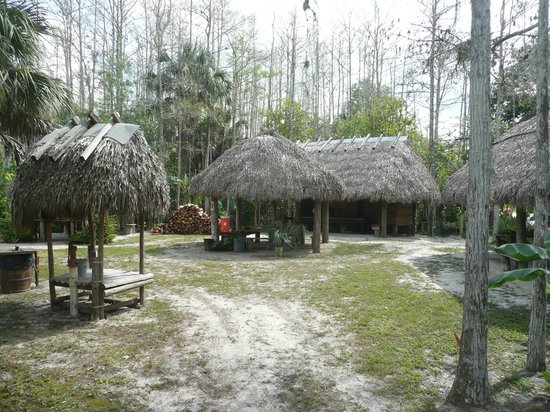
Outside the museum, a raised boardwalk path leads through a cypress grove, past the Clan Pavilion which presents background information on the eight current Seminole clans, to a replica ceremonial grounds and village. In the village, craftspeople demonstrate how they make traditional Seminole art pieces, which are then for sale.

photo from tripadvisor.com

Ah-Tah-Thi-Ki also houses a library and an oral history museum. Much of the oral history recordings are available to tribal members only, but the museum posts some podcasts on their webpage. Some of their archival collections are also online.

Big Cypress Reservation is also home to the Billie Swamp Safari, the Junior Cypress Rodeo and Entertainment Complex, and the Big Cypress RV Resort, all of which are tribally-owned. The Seminole Tribe of Florida also owns several other business enterprises across the state (and the world), including the Hard Rock restaurants and casinos, two of which are on their reservations in Tampa and Hollywood, FL.


Resources:

Friday, June 5, 2015

Heard Museum


Name: Heard Museum
Tribe: Pan-tribal, primarily southwestern nations
Location: 2301 North Central Avenue, Phoenix, AZ 85004
Type: Art and History Museum
Visiting Info: Mon-Sat: 9:30am-5pm, Sun: 11am-5pm, First Fri of every month: 6pm-10pm; Admission: $5-$23
Contact: Website, telephone 602-252-8840

The Heard Museum's permanent collections center on two areas: Southwestern Native cultures and contemporary Native art from across North America. In this way, the museum covers both the history of Native people in the Southwest and modern Native culture and experiences expressed through art.

The Heard is well respected for it's sensitive and honest presentation of American Indian culture. They seem to strive to hire Native staff and trustees and to create real partnerships with tribes and artists in order to provide the most accurate representations. It's a place where Native people are telling a story about themselves.


In addition to the art galleries, the museum complex includes beautiful outdoor spaces, an archival library, a restaurant, a coffee shop, two stores, and the American Indian Veterans National Memorial.


The Heard Museum Shop has become a premier Native art dealer, and the museum also provides a book store, Books & More, which offers titles on American Indian and Southwestern art, history, cooking, travel, and children's books. You can shop online from their selections.

The Courtyard Café serves Native/Southwest cuisine such as posolé, fresh-baked tortilla chips, and frybread with hummus made from tepary beans which are indigenous to Arizona.

Linda Lomahaftewa (Hopi/Choctaw) “New Mexico Sunset” 1978.
photo from heard.org.

The Heard Museum hosts events, festivals, dance competitions, community and children's programming, online and video collections, auditorium and amphitheater performance spaces, and a children's courtyard play area. They are also home to the renowned Annual Heard Guild Indian Fair and Market in March.


Resources:
New York Times article from May 13, 1999, "Making Peace With Museums To Celebrate Their Culture; Phoenix Points the Way To Full Indian Collaboration."
Heard Museum on Facebook
Events at the Heard

Wednesday, June 3, 2015

Indian Pueblo Cultural Center

photo from @indianpueblo on Twitter

Name: Indian Pueblo Cultural Center
Tribe: Pueblo
Location: 2401 12th St. NW, Albuquerque, NM 87104
Type: Cultural Heritage Center, Museum, Library/Archive, Event Space, Café
Visiting Info: Museum: Mon-Sun, 9am-5pm (Shumakolowa Gifts closes at 5:30); Pueblo Harvest Café & Bakery: Mon-Thur, 8am-8:30pm, Fri-Sat, 8am–9pm, Sunday Brunch 8am–4pm; Museum admission: $3-$6
Contact: Website, telephone 866-855-7902


The logo of the Indian Pueblo Cultural Center in downtown Albuquerque says, "Gateway to the 19 Pueblos of NM," and it is a great spot for visitors to get a multifaceted introduction to Pueblo culture.

The museum's permanent exhibits detail the history of the people, and a series of small galleries displays contemporary art and pottery from each pueblo, describing the differences in style and form. A small theater has short films highlighting Pueblo artists, and murals from a special project that began in 1976 are displayed on the walls around the Center. The South Galleries and Avanyu Gallery host changing temporary exhibits.

One highlight of most visitors' experience is the dance exhibition hosted by the IPCC every weekend year-round. Performances are scheduled on Fridays at 2pm, and on Saturdays and Sundays at 11am and 2pm in the Courtyard.

photo from IPCC on Facebook

The Shumak'olo:wa Native Arts store is really more of an fine art dealer than a typical museum gift shop. The pieces they have for sale are carefully curated and the staff is particularly knowledgeable about traditional and contemporary Southwest Native art. Prices reflect the artistry and authenticity of the pieces, but customers can trust that they are supporting Native artists and their community. They have some of their pieces for sale online, in addition to a guide for collecting authentic Native American art.

Green chile and bacon pancakes
photo from Pueblo Harvest's Facebook page

The Pueblo Harvest Café and Bakery serves Native/Southwestern cuisine all day with a view of the Sandia Mountains. They also host live music on the patio most nights from 6-9pm. The Café is accessible even if you don't visit the Center's exhibits, and there is a private event space.

The IPCC runs a free shuttle service  between the Center, their Holiday Inn Express & Suites across the street, the Old Town section of Albuquerque, and the Albuquerque Biological Park Zoo. (Note, the Four Winds Travel Center convenience store and gas station on the corner is also Pueblo-owned.)

Friday, May 22, 2015

Aptucxet Trading Post Museum


Name: Aptucxet Trading Post Museum
Tribe: Mashpee Wampanoag
Location: 24 Aptucxet Road, Bourne, MA 02532
Type: Historic site
Visiting Info: open Memorial Day through Columbus Day weekends, 11am to 3pm (4pm in July/August), Tues-Sat. Closed Sunday and Monday. Admission $2-$10.
Contact: Website, telephone 508-759-9487

While there is some debate about the exact history of the site, the Aptucxet Trading Post is believed to be the first post built to facilitate trade between the English pilgrims, the local Native tribes, and the Dutch settlers of New Amsterdam.

The current building is a replica constructed over the top of the original foundation, which was excavated by archaeologists in the 1920's. The stone foundation is said to date back to 1627.

The site is historically important because it would have been the first place that English pilgrims were able to buy supplies that were not imported from Europe by their parent company and an early place for them to acquire goods they needed to pay off their debts to their corporate backers. The Wampanoag people introduced wampum - a traditional trade good made from quahog shells - which was adopted by the settlers as the standard local currency.

The grounds around the museum include a Wampanoag Garden where they grow native plants such as squash, beans, corn, sunflowers, Jerusalem artichokes, gourds, and tobacco. There is also a kitchen garden of herbs and medicinal plants and a wildflower garden.

Other features of the quirky collection of buildings onsite include a replica windmill and salt works, both of which were important structures at the Cape's colonial settlements, and Grover Cleveland's personal train station for his summer home in Bourne, Grey Gables.

Tickets are purchased at the Sagamore Information Booth Gift Shop at the entrance to the site near the parking lot.


Resources:

Monday, May 18, 2015

Mashantucket Pequot Museum and Research Center

credit: pequotmuseum.org

Name: Mashantucket Pequot Museum and Research Center
Tribe: Mashantucket Pequot Tribal Nation
Location: 110 Pequot Trail, Mashantucket, CT, 06338
Type: Museum, Research Library/Archive
Visiting Info: Opening for the season May 15 (through Nov), Wed-Sat 9am-5pm, Admission $12-$20
Contact: Website, telephone (800) 411-9671

After a five-month hiatus for refurbishment under a new director, the Pequot Museum is open again as of May 15, 2015. The museum is hoping to attract greater attention and more visitors with new programs and partnerships with artists.

In the Farmstead area outside, a group of Wampanoag canoe-builders is working on a 36-foot mish8n ("mishoon," the Wampanoag word for canoe), which will be the longest canoe built in New England in the last 200 years when it is completed in June 2015. Visitors can also see a 400-year-old dugout canoe on display inside the museum's exhibits hall.

The Pequot Café is open with a new menu featuring indigenous selections made from local ingredients sourced when possible from Native vendors.

The museum is also offering free work studio space for local Native artists who would like to become Artists in Residence. (For more information contact: bburrell@pequotmsueum.org, 860-396-6960)

And of course, there is still the original 85,000 square feet of permanent, indoor exhibits, including the Pequot Village, a recreation of a 16th Century Pequot settlement before and after contact with Europeans. The movie theater shows The Witness, a 30-minute film about the attack of the Mystic fort by colonists. The "Life on the Reservation," "The Mashantucket Pequot Tribal Nation Today," and the "Portrait Gallery" areas discuss life for Pequot citizens in Connecticut today and the state of the Tribe since they secured federal recognition in 1983.

On the museum grounds, a 185-foot glass tower provides a view across the surrounding tribal land. There are walking and hiking trails and a self-guided tour through the 1780's-era Pequot Farmstead that discusses traditional tribal foods and medicines growing in the gardens.

Additionally, the Research Center includes collections, a library, a children's library, archives, and archaeology and conservation laboratories.